When I left Syria in 2012 as an opera singer, in the wake of the revolution, I assumed my relationship with choral music would remain suspended between distant stages and cities I no longer lived in. Years later, I came back to Sweida, a tired, besieged city, and did not expect to find a musical project that would pull me back into the bass section of a choir, this time with a completely different spirit.
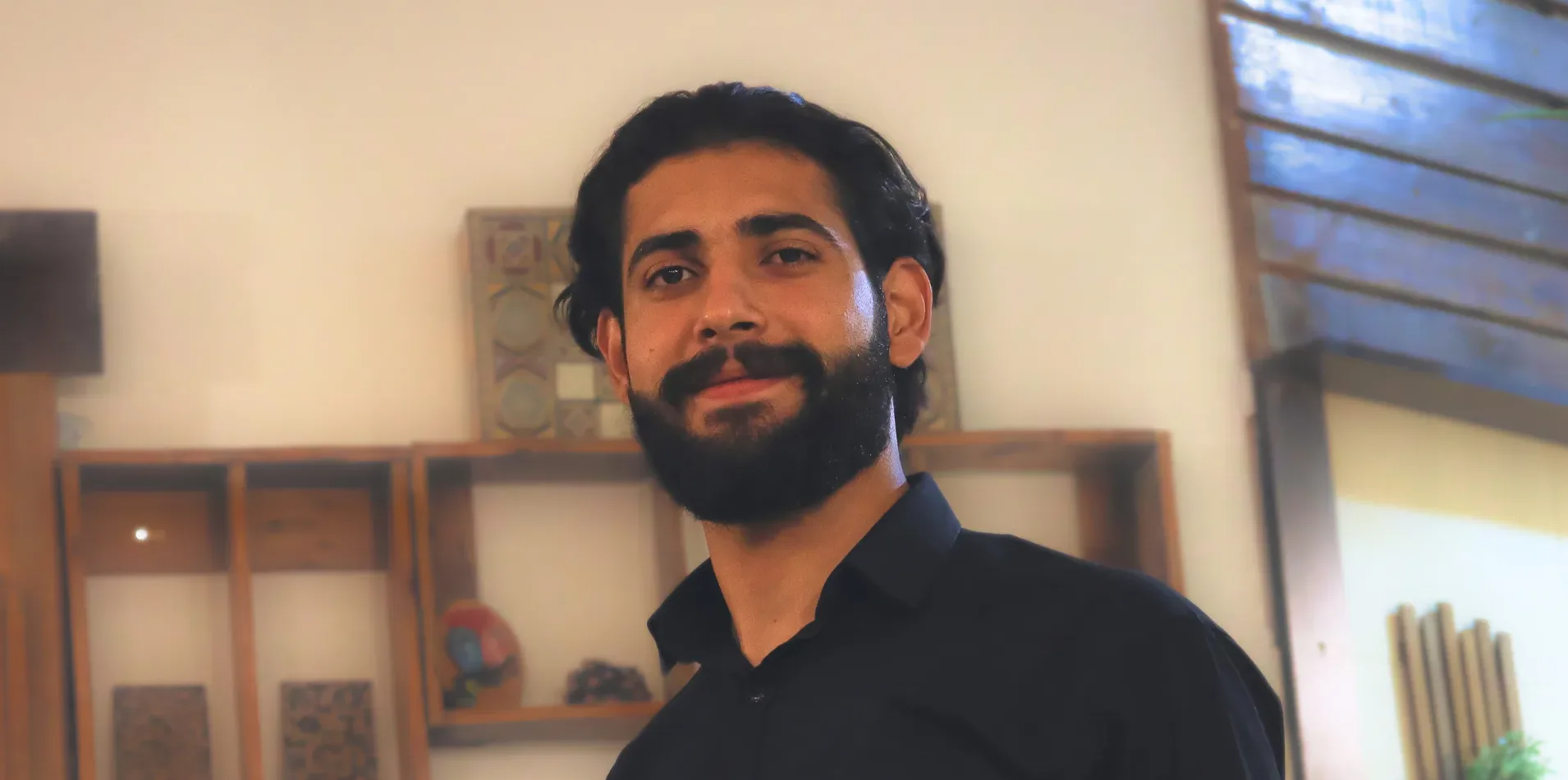
The person who upended that expectation is Daniel Harfoush. Quiet on the surface, relentless underneath, he is essentially obsessed with one question: what happens if we treat the human voice as a full Eastern instrument, and remove everything else, even the last reassuring hit of percussion?
From that question, Oros Choir emerged and with it a very specific experiment in Eastern a cappella. I am no longer just interviewing Daniel about it. I am standing next to him inside it, as one of the bass voices he convinced to join.
What follows is my attempt to tell this story from the inside.
A spark that turned into a method
Oros did not start from a manifesto. It started from a simple impulse: do something for Sweida, something choral and rooted locally. Somewhere along the way the idea sharpened: If we are going to do this, why not commit fully to voices only, and stay rigorously Eastern in pitch, colour and phrasing?
The premise is disarmingly simple: everything in music, even in its lush orchestrated forms, ultimately grows out of the human voice. Strings shadow vocal ranges. Instruments extend what the voice already suggests. In Oros, Daniel reverses the usual hierarchy. The voices stop imitating instruments and simply take their place.
Crucially, he does this without abandoning maqam, quarter tones or ornamental phrasing. There is no “Westernisation for the sake of harmony” here. The experiment is not about importing gospel-style a cappella into Arabic. It is about asking whether a choir can live fully inside Eastern pitch logic and still be structurally tight, harmonically interesting and performable by real people who need to breathe.
![img 0370[1]](https://habaq.media/wp-content/uploads/2025/11/IMG_03701-1-683x1024.webp "Daniel Harfoush: When the Human Voice Becomes a Fully Fledged Eastern Instrument")
Follow Oros Choir @oros.choir
Five parts, with gravity at the bottom
Most choirs work in four parts. Oros often works in five, but not by just doubling sopranos or tenors. The most striking choice comes in a playful piece attributed to Fares Hilal, where Daniel writes for soprano, alto, tenor, bass and a human double bass.
The extra part is not on top, it is below. The result is that the perceived “weight” of the texture drops. The low register stops being a static foundation and turns into a moving field in which actual melodic material happens. The choir does not sit on a bass line, it rides on a low two–part engine.
The melody does not belong to the sopranos, only
Coming back as a bass singer, I know exactly what it feels like to be the invisible infrastructure. In most classical settings, the main line sits comfortably in the soprano while the rest of us hold up the building.
In Oros, that rule is suspended. In the Hilal piece, the primary theme starts in the double bass, at the very bottom of the texture, then migrates through the parts. It climbs, disappears, reappears in other voices.
This is not a gimmick. It is a deliberate redistribution of agency inside the choir. The bass is allowed, and sometimes required, to be the hook. The “melodic right” is no longer reserved for the high voices. Structurally, the choir stops behaving like a vertical pyramid and begins to act more like a mesh, where any node can light up.
Harmony under quarter tones
The technical problem is obvious: how do you keep choral harmony clean when you refuse to give up quarter tones?
Daniel’s solution is pragmatic. He keeps the quarter tones where they matter most, in the melodic surface and in carefully chosen lines, and avoids overloading the vertical sonority with microtonal conflict.
In a Bayat context, for instance, the E half–flat remains a strong melodic pole, but the chord spelling underneath might be something like D–G–A. The ear still hears Bayat, but the choir is not asked to construct an impossible microtonal cluster on every beat.
How it lands on listeners
For non–specialist listeners, the dominant reaction so far has been surprise. The question that keeps coming back is a simple one: Why does this sound full when there are no instruments?
People are used to hearing these songs wrapped in oud, qanun, violin and percussion. Removing that wrapper forces the ear closer to the mechanics of what is going on: where the lines cross, how the breathing is coordinated, how the melody keeps reappearing in different registers.
Musicians listen differently. They tend to ask about voice leading, about how the harmony resolves back into the tonic without sacrificing the maqam, about how the singers hold reference without a sustaining instrument underneath.
The honest answer is that there is no secret trick. The phrases are structured in a fairly classical way in terms of tension and release, but the “orchestra” handling that logic is purely vocal and it spans five parts, not four. The discipline is the same, the medium is not.
What is coming next
When I ask Daniel about what is next, he does not talk about a fixed programme, but about lines of exploration. Two of them are already on the table:
- A Fairuz hymn, re–imagined for Eastern a cappella, where the goal is to maintain that particular spiritual charge while letting the choir, rather than a soloist, carry the line.
- A Kurdish traditional piece, performed in Kurdish with no translation, sung by the choir in the original language, keeping its phrasing and rhythmic feel intact.
Both say something about how Oros understands the word “Eastern”. It is not a narrow national frame. It is a shared sound field that stretches from Jabal al Arab to Jazira, Kurdistan and the coast.
A choir as a lab
For Daniel, Oros is not primarily a concert machine. It behaves more like a lab that occasionally opens its doors to the public.
One track in that lab focuses on repertoire and arrangement: choosing material that can actually withstand this kind of treatment, expanding beyond a long initial focus on Bayat, and constantly searching for ideas that feel slightly uncomfortable at first, because they force both writer and singers out of habit.
The other track focuses on training: building exercises and rehearsal habits that let singers move flexibly between parts, feel harmony rather than just count it, and handle the presence and absence of quarter tones without panic. The ambition is fluency, not stiffness.
Underneath all of this is a simple wager: that “Eastern a cappella” can be more than a curiosity, that a choir built entirely on human voices working inside maqam can produce something as structurally rigorous and emotionally charged as any orchestrated work.
As for me, Maxim Abou Diab, I left Syria as an opera singer and came back to stand in the bass line among the voices of Oros. From where I am standing now, this does not feel like the birth of just another choir.
It feels like a slow attempt to renegotiate our relationship with our own voices and with the music of this region, through one collective sound that keeps finding new ways to listen to itself.